
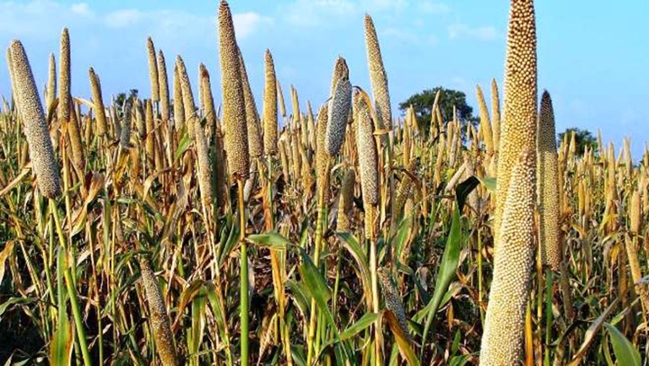
 Millet in Manyoni, Tanzania
Source: ZALF
Tropentag 2025 in Bonn – balancing land use and planetary health
Between September 10 and 12, 2025, this year's Tropentag brought together more than 900 participants from 62 countries in Bonn and online. The scientific conference focused on the question of how agricultural systems can adapt to global challenges. Sustainable land use systems must take into account both, human and planetary health.
Agricultural research plays a central role in finding suitable solutions to the complex challenges – land degradation, climate change, armed conflicts, and crises – affecting agricultural and food systems worldwide. The research results presented at the conference illustrate that special attention must be paid to gender equity and the participation of all. In addition, innovative practices, knowledge-based decision-making, and inclusive governance are crucial for resilient and sustainable agricultural landscapes.
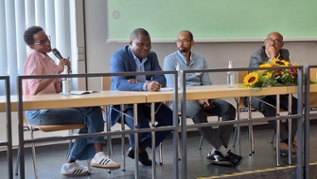
 Panel discussion BMLEH Session.
Source: BLE
The international conference for development-oriented, transdisciplinary, and interdisciplinary agricultural research and rural development in the Global South provided an excellent opportunity for international research projects funded by the Federal Ministry of Agriculture, Food and Regional Identity (BMLEH) to present their work. The projects are being implemented jointly by German research institutions and those in sub-Saharan Africa, South and Southeast Asia, together with relevant stakeholders. In addition, the BMLEH doctoral program specifically funds projects on global food security at departmental research institutions and the Leibniz Institutes of the BMLEH. The BLE serves as the project management agency.
Human, animal and environmental health in times of crisis: BMLEH session highlights ways to strengthen local food systems
The BMLEH session focused on projects funded within the BMLEH doctoral program on the topic of "One Health in Food Systems". Five projects are currently being funded as part of the corresponding call for research proposals in 2022. Three of them presented their research approaches for addressing the effects of various crises with appropriate adaptation strategies. The results presented show ways in which local nutrition can be improved and resilience strengthened.
Making global interconnections visible
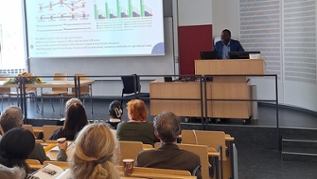
 Presentation of analyses in the frame of the project ICRAFS
Source: BLE
First, Mawussi Kossivi Soviadan from the Leibniz Institute for Agricultural Development in Transition Economies (IAMO) reported on his analyses of the effects of the COVID-19 pandemic and the Russian war in Ukraine on global agricultural commodity trade and food security in sub-Saharan Africa. The analyses conducted as part of the "ICRAFS" project showed that although such shocks have led to a significant increase in food prices in sub-Saharan countries, these can be mitigated in the long term. Proactive, adaptable, and innovative strategies are important for strengthening the resilience of agricultural trade and food supplies in response to future crises. These include disaster preparedness through food storage systems, rapid distribution of relief supplies, and effective crisis management. At the farm level, climate-smart farming practices strengthen the resilience of local production systems and thus food security.
Modular solar dryers for vegetables processing
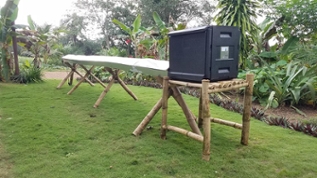
 Modular solar dryer.
Source: UpgradePlus
A safe and sufficient supply of nutritious food is essential for an active and healthy life. Although much food is produced in rural Kenya, the lack of processing facilities poses a major challenge to the availability of a steady year-round food supply. Due in particular to the lack of central power grids, there is a demand for locally adapted, off-grid processing systems. Against this background, Mulugeta Admasu Delele presented the work of doctoral student John Mulwa Ndisya from the Leibniz Institute for Agricultural Engineering and Bioeconomy (ATB) as part of the "REFS" project. In cooperation with local communities, the project works to optimize a modular solar dryer for vegetable processing. The goal is to process food in a way that preserves nutrients and improves its year-round availability for a healthy diet.
Enriching food systems with opportunity crops
The increasing frequency of droughts and dry conditions pose a major challenge for rain-fed agriculture in Tanzania. Local drought-resistant crop species, such as millet are often overlooked. They offer however great potential for making local diets healthier and establishing climate-adapted food systems. Prisca-Elifuraha Kimaro from the Leibniz Centre for Agricultural Landscape Research (ZALF) reported on the "Or-Crop" project. It investigates the role of neglected and underutilized local food crops as a socio-culturally appropriate and ecologically sustainable alternative and evaluates farmer’s willingness to grow them more extensively. Profitability along the value chain plays a particularly decisive role in the success and long-term integration of millet.
The conversations during the session illustrated the diversity of possible approaches to improving the resilience of local food systems and promoting healthy diets. Complex crisis situations must be addressed from a systems perspective so that different adaptation strategies can successfully interlock. Actively involving the local population and taking cultural aspects into account is essential for achieving long-term success.
BMLEH workshop: Interlinking policy recommendations of the UN Committee on World Food Security (CFS) with research
The United Nations intergovernmental Committee on World Food Security (CFS) is the most important body for food security at the international level with the vision to realize the right to adequate food for all. In a participatory and inclusive decision-making processes together with government representatives, multilateral organizations, private sector and civil society actors, the CFS develops various policy documents.
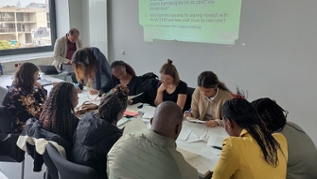
 BMLEH pre-conference workshop.
Source: BLE
Taking the example of the "CFS Voluntary Guidelines on Gender Equality and Women’s and Girls’ Empowerment in the Context of Food Security and Nutrition", workshop participants discussed the opportunities for linking nutrition-related research more closely to CFS policy products, thereby closing relevant knowledge gaps.
Further information
- Tropentag: https://www.tropentag.de/
- Social Media/ Tropentag Blog: https://blog.tropentag.de/
- International research cooperation on global food security: https://www.ble.de/DE/Projektfoerderung/Foerderungen-Auftraege/Internationale-Forschungszusammenarbeit/Forschungskooperationen-Welternaehrung/forschungskooperationen-welternaehrung_node.html
- Right to food: https://www.bmleh.de/SharedDocs/Downloads/DE/Broschueren/recht-auf-nahrung.pdf?__blob=publicationFile


