
Deforestation-Free Products
For the provision of agricultural products in the European Union (EU), forests are being cleared elsewhere in the world. According to the Food and Agriculture Organization of the United Nations (FAO), up to 90 per cent of global deforestation is due to clearing forest for agriculture. This development is driven by the high demand for commodities such as palm oil, soya and cocoa in consumer countries such as the US, China and the EU. For successful international forest protection, agricultural commodities must also be produced without deforestation and forest degradation.
- Start of application: December 2026
- Objectives of the Regulation
- Which commodities are included?
- Obligation to exercise due diligence: what will be expected of operators?
- Duties of the BLE
- Consequences for the EU Timber Regulation No 995/ 2010
- What rules apply to products that already have a FLEGT licence?
- Further information
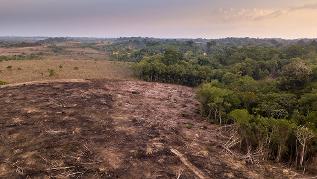
 Source: Paralaxis - iStock/ getty images plus via Getty Images
The EU has therefore adopted legally binding rules. Using an approach of binding corporate due diligence, a new EU regulation aims to ensure the goal of deforestation-free products. Regulation (EU) No 2023/1115 for Deforestation-Free Products was adopted by the European Parliament and the Council of the European Union on 31 May 2023. It came into force on June 29, 2023 and was originally scheduled to start at the end of December 2024 after a transitional period.
Start of application: December 2026
The start of application of the EUDR has been postponed twice at EU level. Market participants must therefore comply with the new due diligence obligations from December 30, 2026. Under certain conditions, small and medium enterprises (SME) will have more time to comply with the new obligations from June 30, 2027.
The Federal Office for Agriculture and Food (Bundesanstalt für Landwirtschaft und Ernährung, BLE) is responsible for the implementation and enforcement of the Regulation in Germany. Above all, the BLE will monitor compliance of the operators with the obligations arising from the Regulation. The monitoring of domestic commodities and products from cattle, soya and timber, on the other hand, will lie within the responsibility of the respective federal state authorities.
Objectives of the Regulation
In order to minimise the EU’s contribution to global deforestation and forest degradation and to reduce the EU’s contribution to greenhouse gas emissions and global biodiversity loss, in the future, relevant commodities and products may only be placed on the EU market, made available in or exported from the EU if
- they are deforestation-free,
- they have been produced in accordance with the relevant legislation of the country of production; and
- they are covered by a due diligence statement
Deforestation-free means that the relevant commodities must not have been produced on land that was deforested after 31 December 2020 or, in the case of timber and timber products, that the timber was harvested without forest degradation having occurred in the respective forest after 31 December 2020.
Which commodities are included?
The regulation applies to the relevant commodities wood, cocoa, coffee, rubber, oil palm, soya and cattle as well as the products derived therefrom in accordance with Annex I of the Regulation.
Obligation to exercise due diligence: what will be expected of operators?
The Regulation requires operators to exercise due diligence before importing relevant products or making them available on the EU market or exporting them from the EU.
1. Operators and non-SME traders
Before placing relevant products on the market or making them available or exporting them, operators and non-SME traders must exercise due diligence for all relevant products provided by each individual supplier.
Due diligence initially involves the collection of certain information, data and documentation relating to the origin of the consignment. On this basis, a risk assessment is carried out to determine whether there is a danger that the relevant products are not in compliance with the Regulation. If the risk assessment reveals that there is a non-negligible risk, procedures and measures must be taken to mitigate the risk. The goods concerned may only be placed on the EU market, made available in the EU or exported from the EU if there is no risk, or at most a negligible risk, that they are not in compliance with the Regulation.
Simplified due diligence
For relevant commodities and products from countries classified by the EU Commission as low-risk countries, a special arrangement applies, i.e. simplified due diligence.
Due diligence statement
If operators and non-SME traders come to the conclusion that the relevant products comply with the Regulation, they shall submit an electronic due diligence statement via the information system set up by the EU Commission prior to placing the products on the market, making them available or exporting them.
2. SME traders
In contrast, SME traders may only make relevant products available on the market if they collect and document information on buyers and sellers.
Duties of the BLE
The BLE will carry out checks on operators and traders established in Germany as well as on relevant products, using a risk-based approach. Minimum inspection rates apply, which differ depending on the classification of the countries by the EU Commission:
- Low-risk countries: minimum inspection rate of 1 per cent
- Standard-risk countries: minimum inspection rate of 3 per cent
- High-risk countries: minimum inspection rate of 9 per cent
Further duties of the BLE will include:
- the detection, elimination and prevention of violations,
- the taking of provisional or immediate measures,
- the punishment of violations,
- co-operation with customs authorities, with (customs) authorities of other Member States and with the Commission.
Consequences for the EU Timber Regulation No 995/ 2010
The Regulation on deforestation-free products repeals the EU Timber Regulation No 995/2010 (https://www.ble.de/DE/Themen/Wald-Holz/Handel-Holz/EU-Holzhandelsverordnung/eu-holzhandelsverordnung_node.html) with effect from 30 December 2026. However, for a transitional period of three years until 31 December 2029, the EU Timber Regulation will continue to apply to timber and timber products produced before 29 June 2023 and placed on the market from 30 December 2026.
What rules apply to products that already have a FLEGT licence?
Timber products that fall within the scope of Regulation (EC) No 2173/2005 and are covered by a valid FLEGT licence (https://www.ble.de/DE/Themen/Wald-Holz/Handel-Holz/FLEGT/flegt_node.html) are considered legal under the Deforestation-Free Products Regulation, i.e. produced in accordance with the relevant legislation of the country of production. In order for these products to be placed or made available on the European Union market, they must also be deforestation-free and be covered by a due diligence statement.
Further information
The BLE will update this english site and provide additional information as soon as possible. Currently you can find further information in German.
The EU Commission has already published some helpful information, including a guidance document. You can read and download this information here:
Current information
Legal basis
- Regulation on deforestation-free products (EU) 2023/1115 (PDF, 765 KB, File does not meet accessibility standards.)
- Benchmarking - Annex to the Commission Implementing Regulation (EU) (PDF, 71 KB, File does not meet accessibility standards.)
- Benchmarking - Commission Implementing Regulation (EU) (PDF, 133 KB, File does not meet accessibility standards.)
- Benchmarking - Commission Staff Working Document (PDF, 395 KB, File does not meet accessibility standards.)
Related links
- EU-Kommission: Informationen zur EUDR
- EU-Commission - (Super-)Topic: Deforestation
- EU-Commission - Expert-Group/ Multi-Stakeholder Platform
- BMEL: EU Regulation for Deforestation-Free Products (in german)
- BMEL – Topic: Deforestation-free supply chains (in german)
- BMEL: Forum for deforestation-free supply chains


